View the game here http://www.schemingmind.com/game.aspx?game_id=47165 (note: clicking on the link will take you to the logon page first. Enter "guest" for both username and password. Or better yet, register for an account and start playing! It's free anyway, and it's a nice community).
Played black and lost in 13 moves.
I have asked several of my friends to annotate this game, for a change :)
Read More......
Tuesday, April 25, 2006


Monday, April 24, 2006
My First ICCF Tournament
Just found out today, accidentally, that someone new to ICCF can have their first open tournament for free and get an ICCF ID and rating afterwards. I had just been accepted as a participant to the 2nd ICCF Webchess Open Tournament, due to start this coming June.
Will keep you posted! And if you are not yet an ICCF member and want to join the tournament for free also, here are the instructions:
http://www.iccf-webchess.com/Message.aspx?message=105
In particular, follow the instructions in option c under the "How and when to enter?" section. The email address to send to is vdemian@shaw.ca
Joining also entitles you to a free non-rated introduction game. Just be sure to enter first the tournament before you avail the non-rated game, or you will not be considered a new member in the tournament and will have to pay the fees accordingly. However, I plan to avail of that after the tournament has started, just to make sure I don't get billed unexpectedly :-)
That's it for now. Good game to all! Read More......
Will keep you posted! And if you are not yet an ICCF member and want to join the tournament for free also, here are the instructions:
http://www.iccf-webchess.com/Message.aspx?message=105
In particular, follow the instructions in option c under the "How and when to enter?" section. The email address to send to is vdemian@shaw.ca
Joining also entitles you to a free non-rated introduction game. Just be sure to enter first the tournament before you avail the non-rated game, or you will not be considered a new member in the tournament and will have to pay the fees accordingly. However, I plan to avail of that after the tournament has started, just to make sure I don't get billed unexpectedly :-)
That's it for now. Good game to all! Read More......
Friday, April 21, 2006
Private Game Note feature
It's kinda funny, but after almost a year of playing correspondence chess, only now was I recognizing the value of the "private game note" feature that I suppose is available in almost all cc sites (it's available in both sites I play in, mentioned elsewhere in this blog). With the feature, one can add game comments, series of expected moves, reasons you have for making a move, etc. And all this for your eyes only. It's a handy way of keeping track of your games even if your opponent isn't making any moves for several days, which is what one can expect in turn-based chess. It's also a good way of analyzing one's game, to see whether expected moves are reealized, and if not, where did you made a wrong conclusion. And for me it's a good way of keeping track of my thoughts which I will later use in analyzing a game here on my blog. So if you happen to be as "normal" as I am, you may want to put the feature into good use on your next game.
Good game to all! Read More......
Good game to all! Read More......
Thursday, April 20, 2006
Game versus Palinurus
View the game here http://www.schemingmind.com/game.aspx?game_id=43852 (note: clicking on the link will take you to the logon page first. Enter "guest" for both username and password. Or better yet, register for an account and start playing! It's free anyway, and it's a nice community)
Played white and lost. Resigned after 37 moves. Game ended last 19 April 2006.
Right at 3. Nd5 I disregarded one of the rules in the opening stages of a game: do not move a piece twice unless it will free up more pieces or to capture an opponent’s piece.
4. Bc4 – what was I thinking? Maybe hoping for a late Fool’s Mate? I should have considered it unlikely from the quality of the moves he had been making.
5. Qf3 – indeed! How foolhardy! With 5…Be7, Fool’s Mate is a goner, and I haven’t developed my pieces yet, and my queen is exposed prematurely.
6…O-O early development allowed black to castle well ahead of time, while I still need to move two pieces to do so. At 8, blood is drawn – mine!
At 11, Queen is right back where it started.
The rest of the game is a series of moves that were done haphazardly and in haste, without really giving much attention to the repercussions of each move towards the total development of the pieces. The worst error perhaps would have to be at 29.
The main problem would have to be the lack of a plan, or perhaps lack of depth if ever there was a plan. I may be thinking of capturing a piece or getting into a position, but I had not sufficiently considered the situation. In most cases, I made a move with the intention of gaining a piece advantage only to recognize that the pieces are defended by one more defense than I thought. Too many of that proved to be disastrous, especially with regards to the more important pieces. Read More......
Played white and lost. Resigned after 37 moves. Game ended last 19 April 2006.
Right at 3. Nd5 I disregarded one of the rules in the opening stages of a game: do not move a piece twice unless it will free up more pieces or to capture an opponent’s piece.
4. Bc4 – what was I thinking? Maybe hoping for a late Fool’s Mate? I should have considered it unlikely from the quality of the moves he had been making.
5. Qf3 – indeed! How foolhardy! With 5…Be7, Fool’s Mate is a goner, and I haven’t developed my pieces yet, and my queen is exposed prematurely.
6…O-O early development allowed black to castle well ahead of time, while I still need to move two pieces to do so. At 8, blood is drawn – mine!
At 11, Queen is right back where it started.
The rest of the game is a series of moves that were done haphazardly and in haste, without really giving much attention to the repercussions of each move towards the total development of the pieces. The worst error perhaps would have to be at 29.
The main problem would have to be the lack of a plan, or perhaps lack of depth if ever there was a plan. I may be thinking of capturing a piece or getting into a position, but I had not sufficiently considered the situation. In most cases, I made a move with the intention of gaining a piece advantage only to recognize that the pieces are defended by one more defense than I thought. Too many of that proved to be disastrous, especially with regards to the more important pieces. Read More......
Learning from Mistakes
After a string of losses in my games at www.schemingmind.com, I decided that I will analyze each game where I lost in order to understand what went wrong. Somehow, the mere knowledge of what went wrong helps you from repeating the same. This is also one of the tips to improve one's game by no less than International Grandmaster Maurice Ashley (read the article here http://www.angelfire.com/fl/chessninja/ashley.html for more tips). If this becomes a really good exercise, maybe I could also move on to analyzing the outcome of each and every game, won or lost. This is also one way to fill up this blog :-)
You can find my game analyses on the succeeding posts. If you have the time and inclination, you may want to add your comments. Hopefully, some of you may also be helped by the insights that I will try to glean from this analysis. By the way, you may even find your game here :-) Read More......
You can find my game analyses on the succeeding posts. If you have the time and inclination, you may want to add your comments. Hopefully, some of you may also be helped by the insights that I will try to glean from this analysis. By the way, you may even find your game here :-) Read More......
Monday, January 09, 2006
Improving My Game
One of the usual things one who is excited about chess does is to plunge into games without much concern to the principles behind the game. This has been my case when I started playing correspondence chess. I plunged into the maximum allowed in one site (for nonpaying members) and opened up additional games in another site. I ended up with a lot of games that I hardly think through when making my moves, thereby defeating the primary purpose of correspondence chess: to improve one's game by playing relatively slower games that one can analyze as the game progresses, consulting opening books during the opening part and reviewing and analyzing principles of good play during the middlegame and endgame.
Another thing that novices like me tend to do is to experiment with a lot of opening repertoire. So in one game, I may do the Dutch, with another the English, with another the Sicilian, etc. etc. What I ended up with is a shallow understanding of each particular opening, with very little regard for the logic and the reason for the moves that constitute a particular opening. Plus, undue concentration on opening lines gave me little time to understand the various common traps for unsuspecting players.
So, with the new year (so trite hehe), I decided to develop a strategy. The objective is the same: improve my game to the point that I can play high-quality faster games, like the one required in OTB (on the board) events. I still don't know if I should aim for a particular rating, since I am still finding out what's a typically high rating, if that means anything. Anyway, the lifelong goal is to reach a level of expertise that I am good enough for the GMs :-) To reach this ultimate goal, I need to develop skills, and this is how I plan to do it.
If I am playing white, I have the opportunity of making the first move. For now, I can concentrate on the standard king or queen openings. The usual response from black would usually be a symmetrical move, or a sicilian defense. Of course, there will be other responses from black, but the point is that if I concentrate on this line, I will be able to understand the various responses from black, and play them as well with understanding on its effect on white.
After some time, I can start analyzing variations on white's opening moves, like the reverse sicilian. It seems obvious that what I will be missing out is how to respond as black to non e4 or d4 openings. In these situations that I believe would be minimal, I would need more help from opening books.
Of course, tactical plays and an understanding of traps would always be a separate component so as not to squander the wealth from what the preceding plans could yield for my benefit. Read More......
Another thing that novices like me tend to do is to experiment with a lot of opening repertoire. So in one game, I may do the Dutch, with another the English, with another the Sicilian, etc. etc. What I ended up with is a shallow understanding of each particular opening, with very little regard for the logic and the reason for the moves that constitute a particular opening. Plus, undue concentration on opening lines gave me little time to understand the various common traps for unsuspecting players.
So, with the new year (so trite hehe), I decided to develop a strategy. The objective is the same: improve my game to the point that I can play high-quality faster games, like the one required in OTB (on the board) events. I still don't know if I should aim for a particular rating, since I am still finding out what's a typically high rating, if that means anything. Anyway, the lifelong goal is to reach a level of expertise that I am good enough for the GMs :-) To reach this ultimate goal, I need to develop skills, and this is how I plan to do it.
If I am playing white, I have the opportunity of making the first move. For now, I can concentrate on the standard king or queen openings. The usual response from black would usually be a symmetrical move, or a sicilian defense. Of course, there will be other responses from black, but the point is that if I concentrate on this line, I will be able to understand the various responses from black, and play them as well with understanding on its effect on white.
After some time, I can start analyzing variations on white's opening moves, like the reverse sicilian. It seems obvious that what I will be missing out is how to respond as black to non e4 or d4 openings. In these situations that I believe would be minimal, I would need more help from opening books.
Of course, tactical plays and an understanding of traps would always be a separate component so as not to squander the wealth from what the preceding plans could yield for my benefit. Read More......
Tuesday, December 20, 2005
Queen Alice
This is the newest site I am playing correspondence chess in. Just started playing a few days ago, and I already have a couple of games running (already lost in one!). Rating system is a bit different from Schemingmind.com since there is some sort of a provisional rating period for the first 25 games you will play. Only after will your rating be considered "real". The manner of computing the rating is also a bit different, though it's possible that the approach is different, but the statistical implications are the same (maybe someone could enlighten me?). Schemingmind.com follows the ELO system with a standard deviation (SD) computation to give it a more "relevant" scenario (meaning, the SD allows one to see if the rating given is highly volatile or more or less stable, since a lower SD would indicate that the player is playing (and finishing) a considerable number of games to make the computations relevant, and vice versa.
Also, the ELO system employed at Schemingmind.com allows for computations on a monthly basis, while ratings are computed at QueenAlice everytime you finish a game.
Give it a try! And don't forget to look for me there! www.queenalice.com Read More......
Also, the ELO system employed at Schemingmind.com allows for computations on a monthly basis, while ratings are computed at QueenAlice everytime you finish a game.
Give it a try! And don't forget to look for me there! www.queenalice.com Read More......
Wednesday, September 21, 2005
Deep Blue
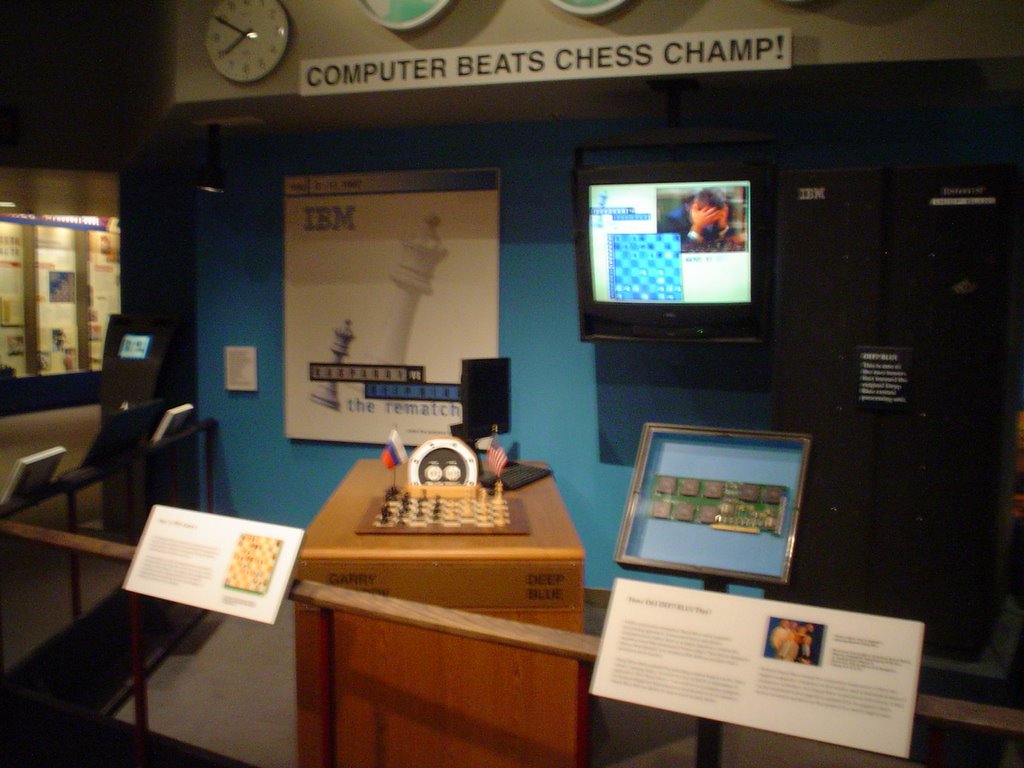
I had the privilege of going to Washington D.C. for about a week, and got a chance to see Deep Blue in one of their huge museums. Deep Blue is the chess program that IBM developed which was able to defeat Kasparov twice, the second game lasting only 19 moves as Kasparov decided to resign. On display was one of the two tower processors (not at all different outside to the usual CPU, it's the black tower to the right side) which is the hardware for the Deep Blue program, as well as the chess table and other chess paraphernalia used during the match.. As the match between human and machine happened a few years ago, and given the exponential development in computing speed, I wonder if the common chess engines today had already exceeded Deep Blue's computing capabilities. Maybe it has. IBM decided not to host anymore matches between humans and programs, as they stated that their goal is to improve on computer's processing capabilities, not to create a mechanical champion. I wonder where it would have led us if they had decided otherwise. Read More......
Correspondence Chess
It's been two months now since I signed up with www.schemingmind.com , one of the several dozen sites dedicated to correspondence chess. So far, it has been such an enjoyable experience. The site allowed me to play against a variety of players I may never even get to meet in person. Although it requires somewhat a different discipline compared to live on-the-board chess games, it allows people like me who are interested in chess to pursue learning and improving on the game at my leisure, since there is no fixed schedule to follow (moves are timed, however, but each move has several days as deadline). The site also opens one up to a host of players who share resources and tips through private comments and open forums. So, if you happpen to be a chess afficionado or simply an occasional enthusiast like me, give it a try! :-)
Read More......
Subscribe to:
Posts (Atom)


