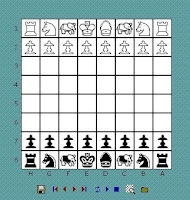
 Being considered one of the predecessor of modern chess, I am a bit reluctant in calling Shatranj a variant. Because it sounds like saying you were born before your mother! Then again, for the casual observer, that's the way this game would look like at first glance. But a few minutes into the game and you would get the feeling that indeed this game isn't a variant after all. Rather, it could have started it all.
 - Shah (king) moves as in std chess
- Rukh (rook) moves as in std chess
- Faras (knight) moves as in std chess
- Baidaq (pawn) moves as in std chess
- Firzan (queen) moves to the first diagonal square
- Alfil (elephant, bishop) leaps to the second diagonal square, never occupying the first diagonal
The rules of Shatranj are similar to Standard Chess, with the following exceptions:
There is no initial two-step Pawn move
- There is no en passant capture option
- There is no castling option
- Pawns arriving at the last rank always promote to Firzans
- Stalemate counts as a win
- Bare King counts as a win, provided that your King cannot be bared on the very next move
- Two bare Kings count as a draw
The first major adjustment I made in the game was in the way I treated the Firzan, or the equivalent of the Queen. Here, the Firzans are not as powerful as they are in modern chess. Moving only to the next diagonal squares around it, you can actually consider it as some sort of a bodyguard for the Shah. Which is quite logical and reasonable if you consider the way of the courts of the kingdoms of the world, where the "general" doesn't exactly go to the ends of the earth and leaves his sovereign.
The second thing to consider is the pace of the game. It's a whole new game if your Alfil has to take three moves to get to the other side of the board, rather than the sweeping motion it can normally do in chess. That, plus the restrained movement of the Firzan, and you have a much slower game, that unfolds more gradually. In my opinion, this game also requires more strategizing, rather than a "bring down the wall" type of chess that we often see.
It's also an influence on me to play on Schemingmind's piece set for Shatranj, as featured above. They succeeded in retaining the feeling of an "ancient" game. I can't help but feel and imagine those Persian folks dressed in their traditional garments, pushing rock sculptures of their digital counterparts that I click and drag.
I would have wanted to post my recent Shatranj game here, but I was thinking that chess publishers would probably render the Alfils and some other pieces in modern chess equivalent. Best that you head over to Schemingmind and try it yourself, as well as the rest that the site has to offer.
Know more about Variants! Click HERE!


